By Dr. Mani Vadari, President, Modern Grid Solutions
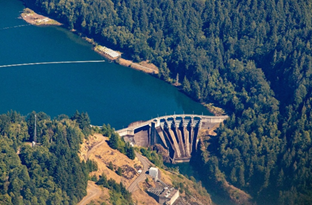
Image: “Mayfield Dam and Lake Mayfield — Cowlitz River — Washington State 03,” by Bobjgalindo. Licensed under CC BY‑SA 4.0.
Washington’s Clean Energy Transformation Act (CETA) sets some of the most aggressive clean‑energy deadlines in the country. Before diving into the affordability impacts, it’s important to understand what the law mandates:
These requirements set the tone for Washington’s energy future — but they also lock utilities into timelines that may not align with technology readiness, grid reliability needs, or affordability for households.
Washington’s CETA was heralded as a bold step toward a carbon‑free future, and it still is. Lawmakers framed it as visionary climate policy, a chance to lead the nation in decarbonizing the grid, which is still an excellent way to go. However, for households across the state, the promise of clean energy is colliding with a harsher reality: mounting costs. What was sold as a climate triumph increasingly looks like an unfunded experiment, with ratepayers footing the bill.
Climate action must remain a priority — for utilities, for regulators, and for citizens. But climate progress is not served by arbitrary timelines that outpace technological maturity or impose unaffordable burdens on households. A sustainable transition requires aligning goals with what the grid can reliably support, what technologies are commercially ready, and what families can reasonably afford. That means adopting an all‑of‑the‑above energy strategy, continuously balancing the mix of renewable, non‑emitting, and dispatchable resources in line with customer rates and system reliability. Ambition matters, but so does pacing and affordability.
The numbers tell the story. Rate hikes tied to clean energy mandates are already hitting households across Washington, and the trend is accelerating. The following three utilities illustrate the scope of the problem: different ownership models, different service territories, yet the same outcome: higher bills for customers.
And Washington is hardly unique. Across the country, utilities are raising rates to finance renewable projects, transmission lines, and compliance reporting. The examples below show how widespread the trend has become:
Analysts estimate over 100 million utility customers nationwide face increased or proposed costs totaling more than $85 billion since early 2025.[i]
The paradox is glaring: CETA requires utilities to expand low‑income assistance programs, acknowledging affordability challenges, while simultaneously driving costs higher. Investor‑owned utilities (IOUs) profit from infrastructure spending, since every new transmission line or renewable project is financed through customer rates. The result is an equity tension: policy gestures toward affordability, but the IOU model guarantees rising bills.
California offers a cautionary tale. Residential electricity rates there now hover around 31–32¢ per kilowatt‑hour, nearly double the national average of ~17¢. Clean energy mandates, wildfire mitigation, and grid modernization have all contributed to the surge.[ii] The consequences are stark: families squeezed financially, businesses relocating, and an affordability crisis deepening.
Washington risks following the same trajectory. If costs continue to climb unchecked, the state’s climate ambitions could unravel under the weight of public backlash.
Behind the scenes, utilities are exploring “creative compliance.” Some buy out‑of‑state market power or purchase renewable energy credits, others stretch definitions of “non‑emitting resources,” and many delay investments until regulators force their hand. Some are even toying with the idea of paying penalties for non-compliance in favor of keeping rates low for their customers.
Critics warn of reliability risks if renewable buildout does not meet demand curve requirements, requiring the need for additional supply resources, such as storage, resulting in further increases in costs. They highlight regressive impacts: rate hikes hit low‑income households hardest, despite assistance programs. And they point to compliance gamesmanship—meeting the letter of the law but not its spirit.
If utilities fail to comply, penalties fall on shareholders, not customers. However, for ratepayers, the dilemma is stark: they fully finance clean energy compliance through ever‑rising bills. Under CETA, while utilities cannot recover penalty costs through their rate base, it creates a perverse incentive of forcing compliance costs onto households while treating penalties as a last‑resort shareholder expense. The law ensures ratepayers always pay for the transition, but never for the consequences of failure.
CETA and other similar policies are bold, and such efforts must be supported, but in practice, they function as massive unfunded mandates on households. Rate hikes are already here, and more are on the way. California’s lesson is clear: affordability collapses when electricity costs spiral, undermining equity goals. Clean energy isn’t free, and someone must always pay. Right now, that someone is the ratepayer.
A sustainable clean‑energy future demands ambition, but it also demands realism. Washington can lead on climate without repeating California’s affordability crisis if policymakers ground their goals in technological readiness, economic feasibility, and a balanced, all‑of‑the‑above resource mix. The path forward isn’t abandoning climate commitments; it’s aligning them with what utilities can reliably deliver and what households can reasonably afford. A transition built on pragmatic timelines and honest cost assessments will earn public trust, protect vulnerable customers, and ultimately make Washington’s clean‑energy vision durable.
[I] Clean Energy Transformation Act (RCW 19.405): https://app.leg.wa.gov/rcw/default.aspx?cite=19.405
[II] Puget Sound Energy rate case (2024–2025): https://www.utc.wa.gov/news/2024/puget-sound-energy-rate-case-decision
[III] Avista Clean Energy Implementation Plan: https://www.myavista.com/about-us/our-commitment-to-clean-energy
[IV] Tacoma Public Utilities rate adjustments: https://www.mytpu.org/news/tpu-approves-rate-adjustments
[V] KPBS. “Hike in Electricity and Natural Gas Rates Coming Next Month for SDG&E Customers.” December 16, 2025. https://www.kpbs.org/news/quality-of-life/2025/12/16/hike-in-electricity-and-natural-gas-rates-coming-next-month-for-sdg-e-customers
[VI] WTOL. “Nessel Announces Intent to Challenge Consumers Energy’s $240M Gas Rate Hike Request.” December 18, 2025. https://www.wtol.com/article/news/local/michigan/nessel-announces-intent-challenge-consumers-energys-240m-gas-rate-hike-request-in-michigan/69-68cb43a5-d9da-47d6-a148-766af125aefe
[vII] Shore News Network. “NJ Environmental Group Demands Action After Electricity Rate Hikes Tied to PJM Auction. December 18, 2025. https://www.shorenewsnetwork.com/nj-environmental-group-demands-action-after-electricity-rate-hikes-tied-to-pjm-auction/
[VIII] WFAE. “Customers Push Back Against Steep Rate Hikes as Duke Energy Reports High Profits.” December 18, 2025. https://www.wfae.org/energy-environment/2025-12-18/customers-push-back-against-steep-rate-hikes-as-duke-energy-reports-high-profits
[IX] Center for American Progress. “Electric and Natural Gas Utility Rate Hikes Tracker.” December 8, 2025. https://www.americanprogress.org/article/electric-and-natural-gas-utility-rate-hikes-tracker/
[X] US Energy Information Administration. Electric Power Monthly: Average Retail Electricity Prices.” Accessed December 18, 2025.https://www.eia.gov/electricity/monthly/
[XI] Baker Home Energy. “California Electric Rate Increases – October 2025.” October 12, 2025. https://bakerhomeenergy.com/blog/2025-10-13/ca-electric-rate-increases-october-2025-blog/
[XII] Washington State Department of Commerce. Clean Energy Transformation Act (CETA). Accessed December 18, 2025. https://www.commerce.wa.gov/energy-policy/electricity-policy/ceta/
[XIII] Washington State Legislature. “RCW 19.405.090: Enforcement – Penalities.” Accessed December 18, 2025. https://app.leg.wa.gov/rcw/default.aspx?cite=19.405.090

©2024 Modern Grid Solutions
Designed & Maintained by Team Mango Media.
