By Dr. Mani Vadari, President, Modern Grid Solutions

Source: Microsoft Copilot (AI‑generated image).
Every utility leader today is grappling with the same reality: the grid is constrained in more places, more often, and for more reasons than ever before. Load growth (accelerated by data centers and other large loads), electrification, DER integration, and extreme weather are converging to stress infrastructure that was never designed for this level of complexity or rapid change. Planning cycles are moving from 15-20 timeframes to 3-5 years.
Historically, transmission congestion was viewed as a problem to be solved with more steel in the ground – more capacity, more lines, expanded substations, and so on. Today, congestion is prompting utilities to deploy a broader suite of grid‑enhancing technologies (GETs) that increase transfer capability, redirect flows, provide localized congestion relief, and optimize the network in real time. These solutions fall into three complementary categories:
Distribution‑level constraints, from hosting capacity limits to EV clustering and DER variability, are pushing utilities to adopt a new generation of distribution‑enhancing strategies that improve flexibility, visibility, and control. These include:
Together, these approaches help utilities manage uncertainty, maintain reliability, and avoid overbuilding in areas with highly dynamic load and DER growth, all with a focus on maintaining/enhancing reliability while keeping a watchful eye towards affordability.
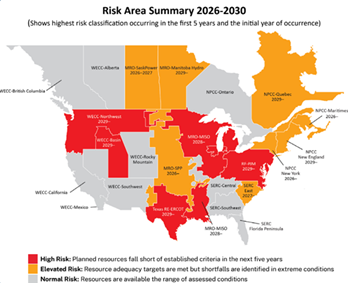
The NERC 2025 Long‑Term Reliability Assessment (LTRA) makes one point unmistakably clear: grid constraints are emerging across every region of the country, driven by rapid load growth, resource retirements, extreme weather, and transmission limitations. While the specific risks vary by region, the national pattern is consistent: reliability margins are tightening, and the grid is becoming more sensitive to stress events.
Across the U.S., NERC highlights several cross‑cutting themes:
Taken together, these trends don’t just highlight risk; they clarify where modernization will have the greatest impact. The constraints are real, growing, and increasingly consequential, and they demand modernization, not incremental fixes.
The pressures facing today’s grid aren’t just technical. They’re also organizational. Modernization requires more than new tools; it requires new ways of thinking, collaborating, and engaging, both within the utility and externally. As constraints multiply and planning horizons compress, utilities that thrive will be the ones that break old patterns, embrace cross‑functional problem‑solving, and treat innovation as a shared responsibility rather than a specialized function.
The grid will always have constraints; that’s the nature of a complex, interconnected system. The utility cannot design and build a gold-plated system that accommodates all alternatives – it would be too expensive and unaffordable for most people. The question is whether we treat constraints as obstacles or as directional cues pointing toward smarter, affordable, and more resilient ways of operating.
In 2026, the utilities that lead will be the ones that recognize constraints as early indicators of where innovation can deliver the most value and who respond with urgency, clarity, and a modernization mindset. A more constrained grid isn’t a setback; it’s a moment of focus that’s revealing exactly where the system is ready to evolve next.

©2024 Modern Grid Solutions
Designed & Maintained by Team Mango Media.