Align Planning Horizons Across All Four Layers
Today, energy, computing, data, and intelligence operate on separate timelines, with separate planning processes and separate incentives. That must change.
We need shared forecasting, shared visibility, and shared accountability and commitment among utilities, large-load developers, policymakers, and regulators. Data center developers know their five- to ten-year load forecasts. Utilities know where capacity can be built and how long it will take. Policymakers know where growth is desired and where constraints exist. Intelligence — AI and advanced analytics — can help all three see further and act faster.
Alignment is the first step. Without it, nothing else works.
Redefine Interconnection for the World We’re Actually Building
Incremental tweaks will not get us there. We need a structural redefinition of what it means to deliver power to a customer, large or small.
That means streamlined study processes, queue management reforms, and proactive planning. It also means recognizing that not every load needs a traditional grid connection. Some loads may be better served by microgrids, behind-the-meter generation, very-close-to-the-meter (VCFTM) solutions, or hybrid arrangements.
Utilities should be positioned — and allowed — to provide backup power, microgrid services, and ancillary services. If a data center needs backup power, the utility should be able to provide it. If a microgrid is the right solution, the utility should be able to build and operate it. If a customer needs ancillary services, the utility should provide them.
Right now, everyone is being forced to become an energy expert. That is inefficient. There is no reason for a company like Amazon to build and manage its own power and energy team. The utility should own the energy equation.
The Federal Energy Regulatory Commission (FERC) is also beginning to recognize that the current model cannot support the scale and speed of modern load growth. By the end of June 2026, FERC is expected to take formal action on its Advance Notice of Proposed Rulemaking for large‑load interconnections — a process initiated at the direction of the U.S. Department of Energy. The goal is to establish standardized, nondiscriminatory rules for connecting loads greater than 20 MW.[i] It’s an important step, but it still operates within the boundaries of a system designed for a different era. True progress requires not just new rules, but a redefinition of what “interconnection” means in a world where computing, data, and intelligence evolve far faster than traditional infrastructure.
If new tariffs are required to meet the needs of these emerging customers, we should not hesitate to create them, and utilities should be empowered to work together across service territories whenever collaboration delivers a faster, more efficient interconnection.
Build Ahead of Demand — Not Behind It
If we continue building infrastructure reactively, we will always be behind.
We need strategic transmission corridors, pre-identified routes for high-capacity lines, coordinated permitting across jurisdictions, and standardized, repeatable engineering. We need to do the hardest parts — routing, permitting, environmental review — once, not for every project.
Energy corridors could be to the AI revolution what the interstate highway system was to American mobility and what fiber‑optic backbones were to the expansion of the internet: the enabling infrastructure that unlocks scale, speed, and economic transformation. Without them, growth is fragmented and slow; with them, entire industries accelerate.
“Time to power” must become a critical metric. Regions that shorten it will win the economic competition for the next century.
Rethink the Paradigms of Energy, Computing, Data, and Intelligence
This is where the real transformation happens.
Energy: Rethink how we deliver power. The utility must own the full energy equation — grid, behind-the-meter (BTM), front-of-the-meter (FTM), VCFTM — and deploy the right model for the right customer, rather than forcing every load through a single interconnection pathway.
As Jensen Huang recently noted, energy abundance and compute abundance are deeply linked: regions with plentiful energy can scale compute less efficiently, while regions with constrained energy must optimize every watt. That reality makes U.S. energy scarcity not just an infrastructure issue, but a competitiveness issue.[i]
Computing: Rethink how and where compute happens. The assumption that bigger data centers are always better no longer holds. As communications become faster and cheaper, distributed architectures may deliver more value, resilience, and efficiency than ever‑larger campuses.
Data: Rethink how data moves. We need to understand where data is created, where it is consumed, and what it costs to move it. In some cases, compute may need to shift closer to the data to reduce latency, infrastructure strain, and total system cost.
Intelligence: Rethink how the system is orchestrated. Intelligence is the differentiator — the layer that optimizes the others in real time. As energy, computing, and data become increasingly commoditized, intelligence becomes the source of adaptability, speed, and competitive advantage. The more evenly spread it is, the more effective and valuable it can be.
Treat Computing as Critical Infrastructure
Compute is now as foundational as water, telecom, and transportation. Every sector depends on it — including the grid itself.
That means integrating compute growth into utilities’ Integrated Resource/System Plans (IRPs and ISPs), coordinating siting decisions with transmission planning, and aligning permitting timelines with realistic deployment schedules. It means recognizing that while compute developers choose their locations and their line of sight to value, utilities become the enabler, defining where energy/capacity exists, can be built, or can be delivered.
If we treat compute as discretionary, we fall behind. If we treat it as critical infrastructure, we lead.
The U.S. government is trying to stay ahead of the curve. Its emerging “speed to power” initiative aims to accelerate the development, permitting, and interconnection of large-scale power infrastructure — particularly to meet the surge in demand from AI data centers and advanced manufacturing.[i] It is a meaningful signal that Washington understands the stakes. But it is not enough. These efforts still operate within the same fragmented processes that created the delays in the first place. Speed to power helps at the margins, but without a fully integrated approach across energy, computing, data, and intelligence, we will continue to build the future on top of yesterday’s fragmented and archaic operating model.
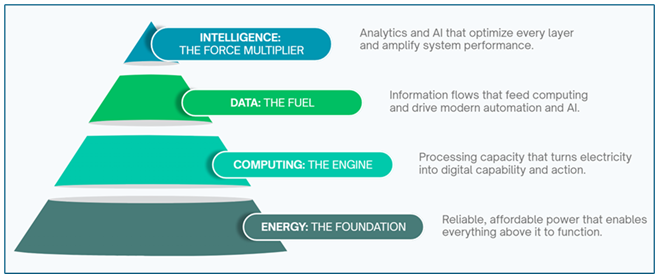 In Part 1, we established that the next century will be shaped by four interdependent layers: energy, computing, data, and intelligence. Each is advancing rapidly on its own. The problem is that they are not advancing together. The system is not failing; it is misaligned. And misalignment, not technology, is threatening our ability to build the future we all want and need.
Part 2 is about the journey forward. This article represents a practical roadmap for building an integrated system that delivers value to everyone — utilities, large-load developers, regulators, communities, and the industries that depend on them.
And to be clear: none of the four layers can dominate the conversation. Energy, computing, data, and intelligence are equal pillars of the system we are trying to build, and we need them all to succeed. If we focus too much on one — or not enough on another — we create new bottlenecks even as we solve old ones. Over-index on energy, and we miss the architectural shifts happening in computing. Over index on computing, and we ignore the data flows and physical realities that make it possible. Over-index on data, and we overwhelm the infrastructure beneath it. Underinvest in intelligence, and the entire system becomes slower, more expensive, and less adaptive.
The opportunity — and the responsibility — is to design a future in which all four layers advance together, reinforcing one another rather than competing for priority.
This matters now because the pace of innovation has outstripped that of infrastructure, and without alignment, the future will arrive faster than we can deliver it or use it to its full potential.
In Part 1, we established that the next century will be shaped by four interdependent layers: energy, computing, data, and intelligence. Each is advancing rapidly on its own. The problem is that they are not advancing together. The system is not failing; it is misaligned. And misalignment, not technology, is threatening our ability to build the future we all want and need.
Part 2 is about the journey forward. This article represents a practical roadmap for building an integrated system that delivers value to everyone — utilities, large-load developers, regulators, communities, and the industries that depend on them.
And to be clear: none of the four layers can dominate the conversation. Energy, computing, data, and intelligence are equal pillars of the system we are trying to build, and we need them all to succeed. If we focus too much on one — or not enough on another — we create new bottlenecks even as we solve old ones. Over-index on energy, and we miss the architectural shifts happening in computing. Over index on computing, and we ignore the data flows and physical realities that make it possible. Over-index on data, and we overwhelm the infrastructure beneath it. Underinvest in intelligence, and the entire system becomes slower, more expensive, and less adaptive.
The opportunity — and the responsibility — is to design a future in which all four layers advance together, reinforcing one another rather than competing for priority.
This matters now because the pace of innovation has outstripped that of infrastructure, and without alignment, the future will arrive faster than we can deliver it or use it to its full potential.