By Dr. Mani Vadari, President, Modern Grid Solutions
AI demand is accelerating faster than the institutions responsible for managing it.
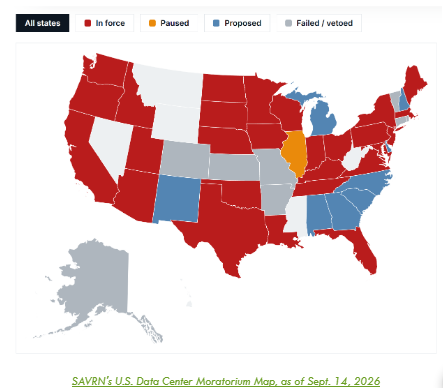
Across the United States, communities are pausing or restricting data center development at a scale we’ve never seen before. According to SAVRN’s Data Center Moratorium Tracker, currently more than 360 local jurisdictions across 43 states have adopted some form of data center moratorium, pause, siting restriction, or related measure, illustrating the growing local response to rapid data center development.
But the proliferation of moratoria is not the headline. The headline is what these pauses reveal: AI-driven load growth is outpacing the coordination capacity of the institutions responsible for planning, permitting, and governing large loads.
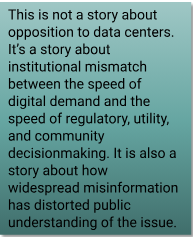
In my recent “Watt’s on Mani’s Mind” blog on Demystifying Data Center Myths, I highlighted how misinformation is shaping public perception, from fears of skyrocketing rates to concerns about water contamination or unchecked land-use impacts. These narratives spread faster than the facts, and moratoria often become a defensive response to uncertainty rather than a reflection of actual impacts.
At the same time, my two-part series on Energy, Computing, Data, and Intelligence underscored a deeper challenge: the convergence of digital and physical infrastructure is accelerating far faster than the institutions responsible for managing it. AI-driven load growth is not incremental; it is systemic and goes far beyond AI. And systemic growth requires systemic coordination.
Moratoria sit at the intersection of these two forces:
While some communities are rejecting data centers, the broader signal is that the current coordination framework is falling short, highlighting the need for better communication and more effective ways to ensure unbiased, factual information reaches all stakeholders.
Moratoria are not the end state. They are the pause before a new coordination model emerges. Moving beyond them will require a multi-faceted approach that addresses both institutional capacity and public understanding.
Utilities, regulators, water authorities, zoning boards, and environmental agencies need synchronized processes, shared forecasting models, and parallel decision pathways. This is the core institutional modernization challenge, and the foundation for long-term stability.
Communities need clear, accessible explanations of:
My Data Center Myths article provides a strong starting point for this work.
Moratoria often arise from fears that:
These concerns must be addressed directly with transparent data, case studies, and regulatory guardrails. The Clarion Ledger recently reported that data centers helped lower Mississippi Power bills by stabilizing load and improving cost recovery — a powerful counter-narrative to the “data centers raise rates” myth. Entergy has likewise reported that agreements with data center customers are generating direct savings for ratepayers by shifting a larger share of grid investment and maintenance costs away from existing customers.
Data centers can:
These benefits must be communicated consistently and backed by real examples. As I wrote in a previous Watt’s on Mani’s Mind post, discussions too often focus on perceived risks, yet large‑load projects can also drive investment in grid upgrades, community services, and local development. When approached strategically, data center growth delivers shared value across utilities, governments, schools, businesses, and residents.
State leaders need frameworks that reduce uncertainty, accelerate permitting, and ensure communities have the tools to evaluate large-load proposals without resorting to moratoria.
States like Virginia have demonstrated what effective policy, regulatory, and legislative outreach looks like: coordinated siting frameworks, proactive utility planning, and clear communication channels between developers, regulators, and communities. Mississippi offers another strong example of legislators, regulators, and utilities working together to show how data centers helped lower power bills, countering misinformation before it could drive moratoria.iii And in Oregon’s Umatilla County, coordinated planning has delivered tangible community benefits, from school funding to broadband expansion.
Better long-range planning with developers can:
With better plans, everyone wins.
In my recent writing on the convergence of energy, computing, data, and intelligence, I’ve argued that the next era of grid modernization will require these layers to be synchronized, not siloed. The moratorium wave clearly reflects that same challenge.
Utility digital transformation projects have already shown that technology succeeds only when the surrounding institutions are aligned. OMS, ADMS, DERMS, and forecasting platforms all deliver value only when planning, operations, IT, field organizations, and vendors coordinate around shared processes and decision pathways. The same lesson applies here except that it now involves multiple societal components: the constraint is not only the sophistication of the tools utilities use to forecast or interconnect new load; it’s also the ability of agencies, utilities, regulators, and local governments to act in concert to deliver value to all.
AI demand is accelerating, but the institutions that govern energy, land use, water, and infrastructure are not keeping pace. In conjunction with misinformation, the result is friction: pauses, emergency ordinances, ratepayer-protection orders, moratoriums, and zoning freezes.
They are signals that the coordination architecture of the grid is overdue for modernization, and if not fixed, they become barriers to innovation.
To support the next decade of AI-driven load growth, we will need:
Moratoria are not the end state. They are the pause before a new coordination model emerges.
The Opportunity Ahead
In earlier sections, I noted that modern grid challenges increasingly sit at the intersection of energy, computing, data, and intelligence — a convergence that is reshaping both load growth and the institutions responsible for managing it. The convergence of energy, computing, data, and intelligence cannot succeed without a parallel convergence in how we plan, permit, and govern the infrastructure that supports it.
The bottleneck is not megawatts or water supply; it’s the ability of institutions to coordinate at the speed required by modern digital growth. And nowhere is this more visible than in the rise of large data center clusters. These facilities are becoming foundational to the next decade of AI-driven innovation, but they can only be integrated smoothly if utilities, regulators, and solution providers build the coordination capacity needed to evaluate, site, interconnect, and operate them without friction.
The opportunity ahead is clear: strengthen the institutional architecture, strengthen the communication and engagement of stakeholders, and the grid will be ready for the data center demands of the future.

©2024 Modern Grid Solutions
Designed & Maintained by Team Mango Media.
